
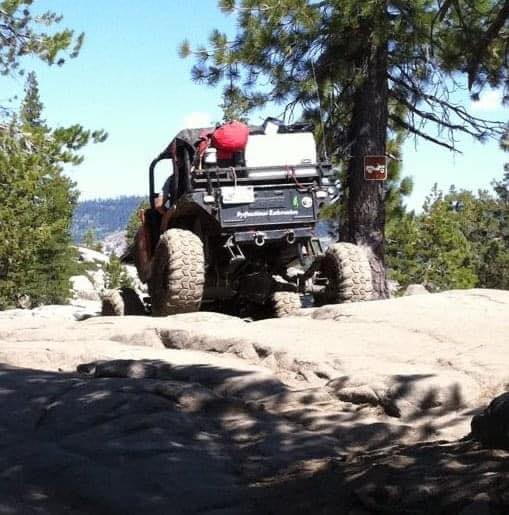
How Friends of the Rubicon (FOTR) Started
Long before modern roads, Indigenous people used a trade route across the Sierra Nevada. When settlers arrived, one of the earliest westbound paths followed what we now know as the Rubicon Trail, dropping to the Rubicon River before turning toward present-day Hell Hole Reservoir.
Over time, the route evolved into a stagecoach road exiting near Georgetown. In 1908, a woman made history as the first to drive the Rubicon Trail, traveling from the Tahoe side down to Rubicon Springs.
But that legacy was nearly lost.
Concerns began to grow about environmental impacts within the Lake Tahoe Basin. Some claimed that vehicle use on the Rubicon Trail was causing erosion and sediment to enter nearby creeks—threatening the clarity of Lake Tahoe.
The Lahontan Regional Water Quality Control Board stepped in and issued a Cease & Desist order to Placer County, effectively requiring the trail to be closed.
When word spread, one man decided to act.
Del Albright rallied a small group of friends, and from that effort, Friends of the Rubicon (FOTR) was born.
Del didn’t just talk—he organized. He brought together more than 20 off-road clubs and mobilized over 200 volunteers. Together, they hauled and placed 180 tons of crushed rock, reinforcing creek crossings and stabilizing erosion-prone areas.
The results were real:
- Erosion was reduced
- Sediment entering waterways was minimized
- The trail became more sustainable
- And Lake Tahoe stayed blue
But this wasn’t a one-day fix.
Del worked closely with Placer County and agencies to develop a long-term stewardship plan—proving that responsible recreation and environmental protection could go hand in hand.
That effort didn’t just save a trail.
It created a movement.
